DERCUM DISEASE :
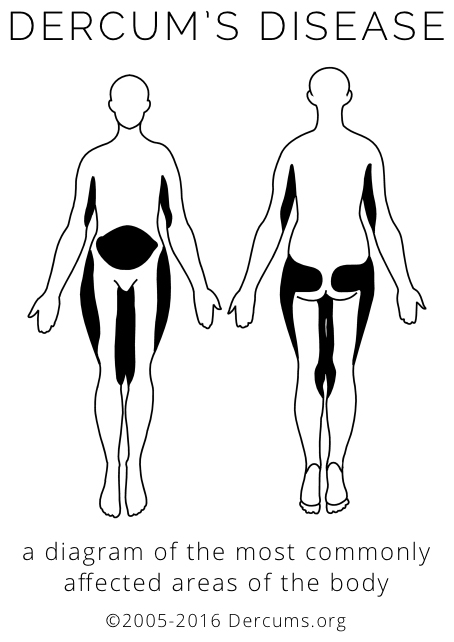
Dercum’s disease is a rare disorder that causes painful growths of fatty tissue called lipomas. It’s also referred to as adiposis dolorosa. This disorder usually affects the torso, upper arms, or upper legs. Dercum’s disease is anywhere from 5 to 30 times more common in women. This wide range is an indication that Dercum’s disease isn’t well understood. Despite this lack of knowledge, there’s no evidence that Dercum’s disease affects life expectancy.
WHAT ARE THE SYMPTOMS OF DERCUM DISEASE ?
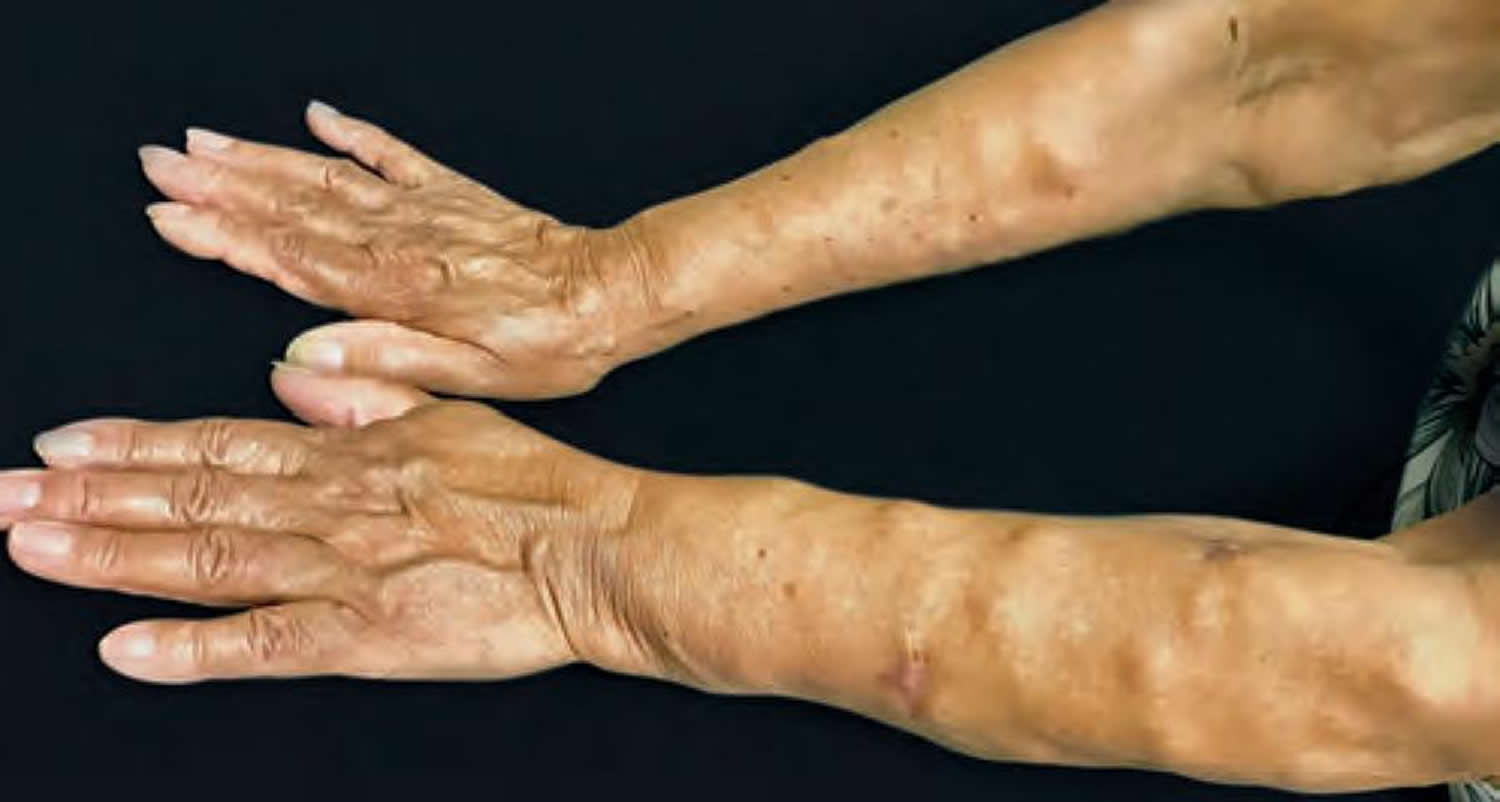
Lipomas associated with Dercum’s disease are often painful when pressed, possibly because those lipomas are putting pressure on a nerve. For some people, the pain is constant. The symptoms of Dercum’s disease can vary from person to person. However, almost all people with Dercum’s disease have painful lipomas that grow slowly. Lipoma size can range from that of a small marble to a human fist. For some people, the lipomas are all the same size, while others have several sizes.
Other symptoms of dercum disease may include :
- weight gain
- swelling that comes and goes in different parts of the body , often the hands
- fatigue
- weakness
- depression
- problems with thinking , concentration , or memory
- easy bruishing
- headache
- rapid heart rate
- shortness of breath
- constipation
WHAT ARE THE CAUSES OF DERCUM DISEASE ?
It may by an autoimmune disorder, which is a condition that causes your immune system to mistakenly attack healthy tissue. Others believe it’s a metabolic problem related to not being able to properly break down fat.
HOW IS DIAGONSED MADE ?
This involves taking a small tissue sample and looking at it under a microscope. They may also use a CT scan or MRI scan to help them make a diagnosis.There’s no standard criteria for diagnosing Dercum’s disease. Instead, your doctor will likely focus on ruling out other possible conditions, such as fibromyalgia or lipedema.
Diagnosed with Dercum’s disease, your doctor may classify it based on the size and location of your lipomas. These classifications include:
1. large lipomas, usually around your arms, back, abdomen, or thighs
2. small lipomas that are widespread
3. a combination of both large and small lipomas
HOW TO TREAT DERCUM DISEASE ?
Surgical removal of the damaged adipose tissue can be effective, but often the disease will recur.Common treatments for Dercum's disease is directed towards treating the individual symptoms. Pain relief medication may be administered to temporarily reduce the discomfort in the patient. Cortisone shots have also been shown to be effective in temporarily reducing the chronic pain.
Few convincing large studies on the treatment of Dercum's disease have been conducted. Most of the different treatment strategies that exist are based on case reports. Currently, there is a lack of scientific data on the use of integrative therapies for the treatment or prevention of Dercum's disease. Not enough studies have been done to substantiate that diet and supplements could help with the disease.
The pain in Dercum's disease is often reported to be refractory to analgesics and to non - steroidal anti inflammatory drugs [ NSAIDs ] . Surgical excision of fatty tissue deposits around joints liposuction has been used in some cases. Liposuction may temporarily relieve symptoms although recurrences often develop. The EEG showed slow waves appearing 7 minutes after the start of the infusion and disappearing within 20 minutes after the end of the infusion. On the other hand, the pain relief effect was the greatest at about 20 minutes after the end of the infusion.
The mechanism of action is unclear. Previously, methotrexate has been shown to reduce neuropathic pain caused by peripheral nerve injury in a study on rats. The mechanism in the rat study case was thought to be a decrease in microglial activation subsequent to nerve injury. The mechanism could be the antiviral effect of the drug, the production of endogenous substances, such as endorphins, or interference with the production of interleukin-1 and tumour necrosis factor. The mechanism for the pain-reducing ability of corticosteroids in some conditions is unknown. One theory is that they inhibit the effects of substances, such as histamine, serotonin, bradykinin, and prostaglandins.
it is plausible that the improvement some of the patients experience when using corticosteroids is not caused by an anti-inflammatory effect.
HOW IS DIAGNOSIS MADE ?
Diagnosis of Dercum's disease is done through a physical examination. In order to properly diagnose the patient, the doctor must first exclude all other possible differential diagnoses. The basic criteria for Dercum's disease are patients with chronic pain in the adipose tissue (body fat) and patients who are also obese. Although rare, the diagnosis may not include obesity.Dercum's disease can also be inherited and a family medical history may aid in the diagnosis of this disease. There are no specific laboratory test for this disease.




Comments
Post a Comment